And then the poems appeared. […] They had to come, because you had to have some shelter where no one could brutally invade, in a word – you had to have a home. You had to say how much it hurt, how bad it was, how much you missed. You had to free yourself from the terrible burden of loneliness. Finally – you had to find something to stop being completely detached, something that would connect you with life.
— Open letter to Julian Tuwim, Ilona Karmel, Stockholm, 1945
The Karmel sisters, Henryka and Ilona, were students of the Hebrew Gymnasium in Kraków. They lived with their parents at ul. Długa 16, and later at ul. Józefa 1. In 1942 they found themselves in the Krakow ghetto, and then in the camp in Plaszow. In 1943 they were taken to the labor camp in Skarżysko-Kamienna, and a year later to a camp in Leipzig. After the the Second World War ended, they spent two years in Stockholm for treatment. In 1947, they made their debut with a jointly written volume of poetry, “Śpiew za drutami” [“Singing Behind the Bars”]. In 1948, Henryka left for the United States, and Ilona followed a year later. Both happily married and started families, and their professional lives in America were connected to writing.
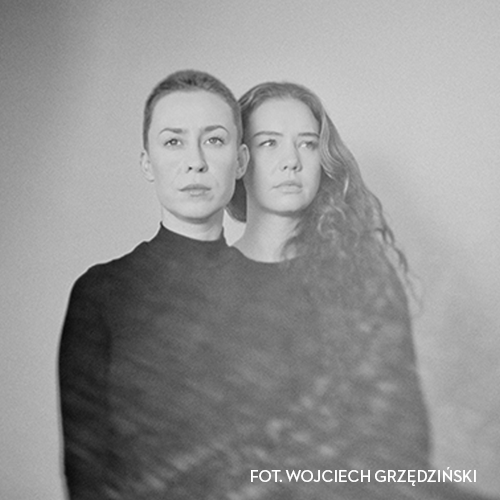
The musical poetry salon based on the poems of the Karmel sisters brings back forgotten Polish-Jewish herstory. It tells the story of young women who fell in love with the poetry of Staff and Tuwim, and who, as a result of the German invasion, had to grow up in a brutal and unnatural way overnight. The poems they wrote in the camp – as Jakub Appenszlak noted in the foreword to their book of poetry in 1947 – became for them “an escape, a shelter, a way of spiritual salvation.” Their poems clearly stand out among the Holocaust literature. They tell of unimaginable suffering and despair, but they also give hope and are proof of the poets’ extraordinary sensitivity.
Directed and scripted by: Zofia Gustowska
Music by: Albert Stensen
Starring: Emma Herdzik, Adrianna Kieś, Albert Stensen (cornet, electronics, piano) and Łukasz Czekała (violin)
After the performance there will be a meeting and discussion with Professor Aleksander Skotnicki and the performing artists, led by Jacek Stawiski – director of the Galicia Jewish Museum in Krakow.
The event is organised by Galicia Jewish Museum, Austeria Publishing House, KL Plaszow Museum, Taube Center for Jewish Life & Learning, JCC Krakow, Jewish Culture Festival, Institute of National Remembrance.
In Polish.
Free admission. Entry tickets available at the museum reception desk.